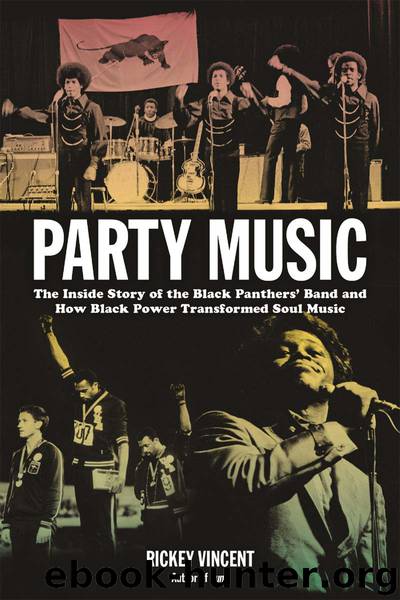
Party Music by Rickey Vincent
Author:Rickey Vincent
Language: eng
Format: epub
Publisher: Chicago Review Press
Published: 2013-08-13T16:00:00+00:00
The Black Panther Party versus the US Organization
The Black Panther Party was at odds with Karenga from the beginning. The Black Panthers saw themselves as revolutionary nationalists as opposed to cultural nationalists. The BPP saw itself as a militant organization in solidarity with anticolonial struggles around the world. They were leaning toward socialism and away from Black Nationalism. They did not see culture as the first step toward a revolution, they saw the black man taking up the gun against police brutality as the first step. As many of the original Panther Party members identified with the working classes or lumpenproletariat, they viewed the ornate artifacts and African-inspired rituals with suspicion. With names like Bobby, Huey, David, and Kathleen, the first Panthers were not known to Africanize their names. Typically, US Organization members saw the Panthers as undisciplined street thugs, as ignorant poseurs seeking the radical spotlight and white acceptance. While their goals were similar, the BPP and the US members would find themselves in one tragic conflict after another.
As the Black Panther Party under the leadership of Alprentice “Bunchy” Carter and the US Organization under the leadership of Maulana Karenga grew in significance in Southern California in the late 1960s, the organizations went from coalitions to confrontations over power in the region. Karenga’s US Organization sought relationships with organizations that it could control, and the initial Black Student Union at UCLA was one such organization. A “community advisory board” to the BSU selected a Karenga-supported choice to head the BSU without student input. The Black Panthers supported a process that included students. The procedural issue exposed a deeper level of conflict between the two forces, and tensions rose that spilled from the university hallways through the street affiliations of the Panther and US membership. Shortly after one tense meeting that was attended by BPP and US members, guns were pulled and two Party members, including Panther leader Carter, were killed.
The deaths of the two Panther leaders, Alprentice “Bunchy” Carter and John Huggins, at UCLA came as a shock to the entire black radical community. (By most accounts Karenga was shocked to hear the news as well.) There was considerable suspicion of collaboration with government provocateurs, and a number of Panthers were arrested on charges related to the shootings—ostensibly as a means to prevent retribution. As a result, the Panthers, who had obtained the majority of popular support among radicals nationwide, began a relentless propaganda assault against Karenga, the US Organization, and cultural nationalism overall. While the US-Panther conflict did not begin with the UCLA shootout in January 1969, that event marked the beginning of the end of Black Nationalist coalitions, and perhaps of the movement overall.
By 1968 the Black Panther Party was established as the most prominent Black Nationalist organization, and its newspaper the Black Panther had a weekly circulation of more than 100,000 copies. When statements about Karenga or cultural nationalism were printed, it served to define cultural nationalism for many who did not know about the distinctions, or about the Panther-US rift.
Download
This site does not store any files on its server. We only index and link to content provided by other sites. Please contact the content providers to delete copyright contents if any and email us, we'll remove relevant links or contents immediately.
| Anthropology | Archaeology |
| Philosophy | Politics & Government |
| Social Sciences | Sociology |
| Women's Studies |
Nudge - Improving Decisions about Health, Wealth, and Happiness by Thaler Sunstein(7717)
The Fire Next Time by James Baldwin(5461)
iGen by Jean M. Twenge(5424)
Adulting by Kelly Williams Brown(4588)
The Sports Rules Book by Human Kinetics(4408)
The Hacking of the American Mind by Robert H. Lustig(4390)
The Ethical Slut by Janet W. Hardy(4272)
Captivate by Vanessa Van Edwards(3848)
Mummy Knew by Lisa James(3700)
In a Sunburned Country by Bill Bryson(3551)
The Worm at the Core by Sheldon Solomon(3496)
Ants Among Elephants by Sujatha Gidla(3476)
The 48 laws of power by Robert Greene & Joost Elffers(3329)
Suicide: A Study in Sociology by Emile Durkheim(3031)
The Slow Fix: Solve Problems, Work Smarter, and Live Better In a World Addicted to Speed by Carl Honore(3020)
The Tipping Point by Malcolm Gladwell(2941)
Humans of New York by Brandon Stanton(2882)
Get What's Yours for Medicare: Maximize Your Coverage, Minimize Your Costs by Philip Moeller(2819)
Handbook of Forensic Sociology and Psychology by Stephen J. Morewitz & Mark L. Goldstein(2719)
